
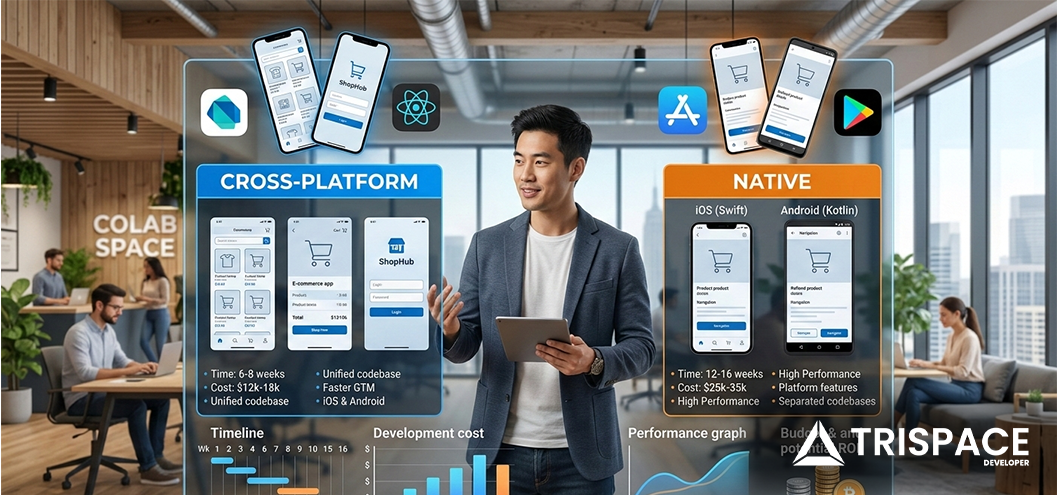
Starting an e-commerce company is exciting. You might be extremely driven, have a distinct target audience, and excellent product ideas. But before you create a complete app, you need something basic to check your idea. An MVP is a basic version often called minimum viable product. Now comes a very important question and that is Should you choose the Cross Platform App Development your e-commerce MVP?
This is a crucial decision since it will influence your cost, speed, and future expansion.
The following blog sheds light on everything about Cross Platform App Development including its advantages and drawbacks so you may choose the best for your company.
What Is Cross Platform App Development?
Building one application that functions on several platforms, among them are iOS and Android by using a single codebase defines cross-platform app development. Rather than developing two different programs, one for iPhone and another for Android, developers write the code once and apply it across both devices. Cross-platform app development can be quite appealing for startups creating an MVP as it saves time and money.
Why It Matters for an E-commerce MVP
An e-commerce MVP usually includes:
- Product listings
- Shopping cart
- Payment gateway
- User login
- Order tracking
Initially, these qualities do not always call for advanced local development. That explains why many businesses see cross platform app development in the early stage. But, is this the right choice for you? First let’s look at the benefits.
Pros of Cross Platform App Development for E-commerce MVP
1. Faster Development Time
One of the main benefits of cross platform app development is speed. Because developers create one codebase, the app can be constructed far faster than creating several native apps. This lets companies start testing the market and swiftly introduce their e-commerce MVP. Speed counts in a competitive situation.
2. Lower Development Cost
In the MVP stage, budget is usually constrained. Developing cross platform apps lowers expenses as:
- One team only is needed.
- Reduced development time
- Easier maintenance
You put your money in a single shared solution rather than paying for two independent apps.
3. Wider Market Reach
Cross Platform App Development lets your e-commerce MVP debut on both iOS and Android simultaneously. This improves your visibility and enables more consumers from day one to download and use your app.
More users present e-commerce companies with more sales possibilities.
4. Easier Maintenance
One code base is easier to administer than two independent ones. Developers modify one version when updates are needed and then apply it to all platforms. This helps to keep Cross Platform App Development in the first phases under control.
5. Good for Testing Business Ideas
MVP is all about testing not perfection.
Cross Platform App Development is very useful for confirming product concepts, observing consumer behavior, and gathering comments prior to committing money to a full-fledged native solution.
Cons of Cross Platform App Development for E-commerce MVP
While Cross Platform App Development has benefits, it also has some limitations.
1. Performance Limitations
Performance usually works well for simple e-commerce systems. Native apps, however, can run better if your program has complex graphics, extensive animations, or advanced features. For really complicated systems, cross-platform app development occasionally falls short of native-level speed.
2. Limited Access to Some Native Features
Some device-specific characteristics might call for more customization. Though Cross Platform App Development has some limits when attempting to use cutting edge hardware features, modern frameworks are improving.
3. Design Differences
The design of iOS and Android vary slightly.
Though Cross Platform App Development strives to balance both systems, occasionally the app might not appear exactly local on either platform. MVP stage typically finds this to be tolerable. But for large-scale expansion, you might think about different optimization later on.
4. Scalability Considerations
You might eventually require more advanced performance tuning if your e-commerce platform expands to millions of consumers.
Cross platform app development can grow, but permanent business systems occasionally shift to more tailored solutions.
When Is Cross Platform App Development the Right Choice?
Cross platform app development is usually a good choice if:
- You are producing your first MVP
- Your financial means are constrained.
- You would want rapid market penetration.
- Your traits aren’t particularly complex.
- You want to check the market fit of your product.
For many new ventures, this strategy helps to validate the business idea before a larger investment and lowers risk.
When It May Not Be the Best Choice
You may want to reconsider Cross Platform App Development if:
- Your program calls for advanced device capabilities.
- You need very high performance
- From day one you are developing a vast corporate system.
- you already have a strong funding system for native apps.
The secret is knowing your business objectives.
A Simple Scenario
Imagine you wish to start an internet fashion company. Basic capabilities such as order tracking, payment integration, and product navigation are needed. Cross Platform App Development lets you develop once and launch on both platforms rapidly in this instance. You can evaluate consumer reaction, enhance the app, then determine whether to grow further.
Native development may provide better performance, though, if you intend to create advanced augmented reality buying experience.
Cost Comparison for E-commerce MVP
Building two different native applications can cost substantially more than using Cross Platform App Development in the United States.
For instance:
- Native iOS app + native Android app costs more.
- One cross platform solution is more cost effective.
Many companies hence go for cross platform app development during the MVP stage.
Choosing the Right Development Partner.
Technology choice is important, but your development partner matters even more. An expert team will evaluate:
- How your company works
- Your ideal audience
- Your money
- Your long-term growth initiatives
Here comes Companies such as Trispace Developer knowing both startup strategy and technological growth. Expert companies such as these enable entrepreneurs to select the best plan depending on actual corporate objectives: Cross Platform App Development or another solution.
Working with experienced professionals reduces mistakes and ensures your MVP is built smartly.
Ready to Build Your E-commerce MVP?
- If you are planning to launch your e-commerce idea, now is the time to decide the right development approach.
- Cross Platform App Development can help you move faster, save money, and reach more users in the early stage.
- Contact Trispace Developer today to discuss your e-commerce MVP and find the best development strategy for your startup.
Conclusion
Choosing the best development strategy for your company is among the most important decisions. For many e-commerce MVPs, cross platform app development provides speed, cost savings, and a broader reach, hence making it a great alternative. Cross platform application development might be the ideal route for entrepreneurs wanting to rapidly and effectively test their idea.
Make a smart decision today, and build a strong foundation for your future growth.
FAQs
Q: What is Cross platform app development?
Ans: Cross Platform App Development is known as a technique of creating one app that runs on several platforms including iOS and Android using one codebase.
Q: Do Cross Platform App Development benefit e-commerce startups?
Ans: Yes. For e-commerce MVPs, it is sometimes perfect as it saves time, lowers cost, and permits quicker market entry.
Q: Is performance lower in Cross Platform App Development?
Ans: Most fundamental e-commerce applications perform well. Native development may also yield better results for really complicated applications.
Q: Does Native development cost more than Cross Platform App Development?
Ans: Yes. Usually, development and maintenance expenses are less because one codebase serves several platforms.
Q: Can I switch to native apps later?
Ans: Yes. Many startups begin with Cross Platform App Development and later expand to native solutions as they grow.