
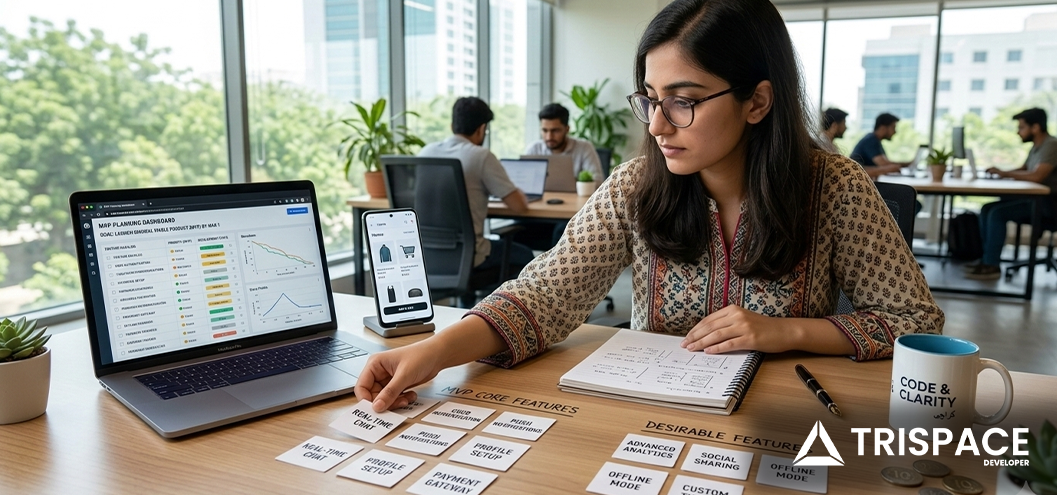
It’s great to launch a new software concept. You could have grand ideas, many features in mind, and hopes of success in the US market. Most successful apps, however, did not begin huge here. Their beginnings were rather small. That little beginning is known as an MVP (Minimum Viable Product). Among the most crucial first steps in planning a new Mobile App Development project is learning how to define your MVP.
What Is a Minimum Viable Product (MVP)?
A Minimum Viable Product is the simplest version of your app.
It consists of:
- Only the most prominent aspects
- Plain but pristine design
- Basic functions
- One true answer to one actual issue
Simply speaking, an MVP is your app’s “starter version.” In mobile app development, creating an MVP lets you test your concept before investing too much money.
Why MVP Is Important in Mobile App Development
Many companies make one major error. On the first try, they seek to create a flawless app.
This results in:
- high development cost
- Long design time
- Features causing uncertainty
- Delayed departure
- possibility of failure
Smart Mobile App Development emphasizes quick releases, early testing, and step-by-step refinement.
An MVP assists you with:
- Verify your idea.
- Obtain user comments
- Decrease financial risk
- Enter the United States market more quickly.
Step 1: Identify the Problem Clearly
Every successful application addresses a need.
Ask yourself before you begin creating your mobile app:
- What issues does my software solve?
- Who is going through this struggle?
- Why does this problem matter?
For instance:
Should you be creating a food delivery app, the challenge might be “People don’t want to cook after work.” Your MVP should concentrate just on resolving this fundamental issue.
Step 2: Define Your Target Audience
You cannot build an app for everyone. Selecting the appropriate audience sets good mobile app development in motion.
Ask:
- Am I an app for students?
- For people working in the fields?
- Does it serve small companies?
- Is it intended for those residing in certain American cities?
Knowing your audience helps you determine which MVP features are actually required.
Step 3: List All Features (Then Cut 70%)
Now comes an essential phase. List every characteristic your app should have. Never pause. Simply lay everything out.
Next, split them three ways:
- Essential Components
- Desirable Capabilities
- Next Features
In Mobile App Development, your MVP should include only “Must-Have” features.
For example:
If you are building a ride-sharing app.
Must-Have:
- User registration
- Book a ride
- Payment system
- Driver tracking
Good-to-Have:
- Promo codes
- In-app chat
- Rewards system
Future Features:
- Subscription plans
- Advanced analytics
- Referral programs
Remember, MVP means simple.
Step 4: Focus on Core User Journey
The primary route a user travels in your application is known as the core user journey. You should create your MVP around this journey in mobile app development.
Ask:
- The first thing the user does is
- What action predominates?
- How does the user approach the task?
Smoothly and simply undertake this trip. Your MVP is excellent if consumers can accomplish their primary objective without confusion.
Step 5: Build a Simple Prototype
Design a basic mockup before coding.
This might be:
- wireframes
- Fundamental display layouts
- clickable example
Before full development, professional mobile app development teams test the idea using prototypes. This saves time and money.
Step 6: Choose the Right Technology. Technology choice matters.
You have to choose:
- Native app (iOS and Android independently)
- Cross-platform program
- System back end
- Cloud platforms
A knowledgeable team in mobile app development will help you pick the most appropriate technology for your MVP.
Step 7: Set Clear Goals for Your MVP
Your MVP must have measurable goals.
For example:
- 1,000 downloads in first 3 months
- 40% user retention rate
- 100 daily active users
Data is absolutely crucial in mobile app development. Tracking performance and user behavior is required after release.
Step 8: Launch Fast, Improve Later
- Do not wait for perfection.
- Many popular programs, including Instagram and Airbnb, began with rather basic tools.
- After receiving user input, they got better.
- That is the might of the MVP approach in Mobile App Development.
Common Mistakes to Avoid
When establishing your MVP, stay away from these errors:
- Including far too many options
- Ignoring user comments
- Bypassing market analysis
- Not planning scalability
- Picking unskilled coders
A carefully designed Mobile App Development approach helps to avoid such mistakes.
Benefits of a Strong MVP Strategy
Defining your MVP appropriately yields:
- Reasonable cost of development
- Quicker launch time
- Actual market confirmation
- Lower risk
- Increased investor belief
- Specific development roadmap
This tactic makes mobile app development wiser and more strategic.
How the Right Development Partner Helps
Finding MVP definitions is not always simple. It calls for technical knowledge, experience, and preparation. Companies like Trispace Developer understand how to transform great app ideas into clever MVP strategies. They emphasize fundamental features, user experience, and scalability rather than developing superfluous bells and whistles. They enable companies to start more quickly and expand gradually by means of a thorough grasp of the USA market and significant mobile app development experience.
Ready to Turn Your App Idea Into Reality?
Don’t let your idea stay just an idea. Define your MVP the right way and build a strong foundation for long-term growth. Work with a trusted Mobile App Development team that understands strategy, scalability, and real business needs.
Contact the experts today and take the first step toward launching your app successfully.
Conclusion
Making an app doesn’t mean developing all at once. Smart companies start by solving one main issue. That is the power of MVP. Start small, test early, and step by step grow if you are planning a new Mobile App Development project. A clear MVP strategy saves money, lowers risk, and increases your chances of success in the competitive market of the USA.
Frequently Asked Questions (FAQs)
Q: What is an MVP in mobile app development?
Ans: The most basic form of an app with only the fundamental features required to address a problem is known as MVP.
Q: How much time does developing an MVP take?
Ans: Usually 2 to 4 months, depending on elements and intricacy.
Q: Is MVP just for startups?
Ans: No. Even major corporations utilize the MVP strategy to evaluate innovative concepts.
Q: May I later include more features?
Ans: Yes. MVP is only the start. Post-launch, you can grow and better yourself.
Q: How much does MVP cost in the United States?
Ans: Features, design, and technology define the cost. A basic MVP is far less expensive than a full-featured program.
Q: Why is MVP important for investors?
Ans: Investors prefer tested ideas. An MVP shows real user data and reduces risk.