
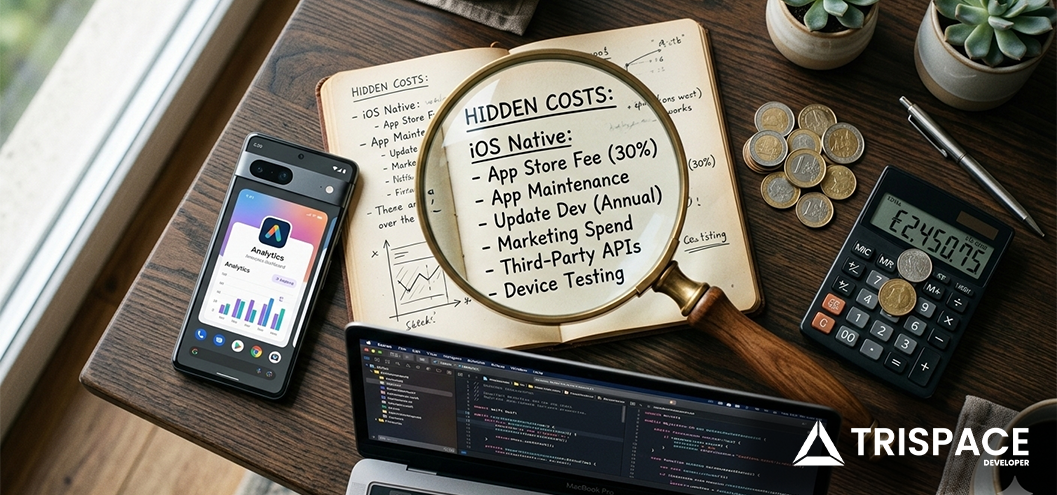
One of the first major decisions companies considering developing a mobile app must make is this: Shall we optcross-platform or native?
Many businesses go with iOS Mobile App Development as Apple customers are reputedly spending more money on applications. Native applications provide great performance and a seamless user experience as well. Native development, however, carries unexpected expenses as many people do not understand.
The following blog will help you to make the best decision for your business by an explanation of the actual costs of selecting native iOS Mobile App Development over cross-platform alternatives.
What Is Native iOS Development?
Native iOS Mobile App Development is the process of creating an application especially for Apple products such iPads and iPhones. Apple’s programming languages like Swift or Objective-C are used by developers.
This strategy enables one to:
- High performance
- Smooth visualizations
- Complete access to Apple features
- Good safety
Sounds great, right? The narrative, though, has more to it.
What Is Cross-Platform Development?
Building one app utilizing a single codebase that works on both iOS and Android under cross-platform development. Tools like Flutter or React Native let developers simultaneously build applications for several platforms.
This typically entails:
- Reduced cost of growth
- Launch at a quicker pace
- Simpler updates
- Independent Team Supervision
Let us next examine the invisible expenses of opting instead for native iOS Mobile App Development.
1. Higher Initial Development Cost
The first secret expense is money. You need a committed iOS team when you decide on iOS Mobile App Development. If later you want an Android version, you will have to pay a separate team to start from the ground up.
That indicates:
- Two groups working independently
- Two distinct ventures
- Two expenditures
You construct once in cross-platform and distribute everywhere. But with indigenous iOS mobile app development, you are buying just one ecosystem.
This can weigh heavily on fledgling companies.
2. Longer Time to Market
Time is money. Your launch schedule doubles if you start developing an Android version from native iOS Mobile App Development. Cross-platform applications can start simultaneously across both systems.
Delays could imply:
- Losing the edge of competition
- Lacking market patterns
- Slower income growth
At the planning phase, this hidden cost is frequently disregarded.
3. Separate Maintenance Costs
Every app needs updates. Maintenance comprises bug fixes, security upgrades, feature enhancements, and iOS compatibility tests. You have to keep your native iOS mobile app development different from Android. You are basically managing two products if you possess both editions.
That implies:
- Separate cycle testing
- Individual changes
- Independent help measures
Maintenance can grow more expensive over time than the development itself.
4. Hiring Specialized Talent
Employing the correct developers is another unseen expense for iOS mobile app development.
In the U.S. market,
- Swift and Apple frameworks specialists among iOS developers may command a premium.
- Talented local developers want better pay.
- Cross-platform developers, meanwhile, may control two platforms together.
Finding, recruiting, and keeping excellent native iOS talent increases your overall expenditure.
5. Feature Duplication
Suppose your company expands and you choose Android expansion. Every component you developed throughout iOS Mobile App Development has to be rebuilt once for Android.
This means:
- Rewriting programs
- UI element design modification
- Reexamination of everything
Small modifications must also be enacted twice. That increases both cost and effort twice over.
6. Complex Project Management
Controlling one app is easy. Two is not manageable. Native iOS Mobile App Development complicates your project management should you eventually broaden to Android.
You require:
- Different time frames
- Independent bug tracking
- Independent quality inspections
This adds to operational expenditures.
7. Higher Scaling Costs
As your audience increases, so too must your infrastructure. Scaling each platform independently helps backend coordination if your company runs on both iOS and Android separately.
iOS mobile app development offers improved Apple device optimization, yet scaling across ecosystems becomes more difficult and costly.
When Native iOS Still Makes Sense
Native iOS Mobile App Development is not a bad option even with secret expenses.
Ideal if:
- Your target audience mostly uses iPhones.
- You have to have strong gaming software.
- Deep Apple hardware integration is needed here.
- Long-term investing is allowed by your budget.
Native development can be quite effective for companies concentrating solely on the Apple environment.
Cross-Platform vs Native: A Quick Comparison
|
Feature |
Native iOS |
Cross-Platform |
|
Development Cost |
High |
Moderate |
|
Time to Market |
Slower |
Faster |
|
Maintenance |
Separate |
Unified |
|
Performance |
Excellent | Very Good |
| Scalability | Platform-Specific |
Multi-Platform |
The right choice depends on your goals, budget, and audience.
How to Make the Right Decision
Consider the following before deciding on iOS Mobile App Development:
- Whom am I meant for?
- Do I also need Android users?
- Over three years, what is my total budget?
- How swiftly do I have to start?
Thinking long-term saves money. Cross-platform first then shifts to native only when needed is sometimes a wise approach.
Choosing the Best IOS Mobile App Development Company
Choosing the best IOS Mobile App Development Company is crucial. Whether to go for native and cross-platform app development is not an easy decision to make. That is where professional Such professional firms offer cross-platform solutions as well as expert direction in iOS Mobile App Development. Before suggesting the appropriate technological stack, their team examines your target market, expansion plans, and company model.
Rather of promoting one choice, they concentrate on:
- Cost effective planning
- Long-term scalability
- Safe and clear coding
- Continuous maintenance assistance
Such a professional company safeguards your expenditure whether you need a smart cross-platform solution or entire native IOS mobile app development.
Final Thoughts
Native iOS mobile app development provides great performance and a premium user experience. But it also has hidden costs like increased development budgets, more extended schedules, and independent maintenance expenditures. Before deciding, consider your long-term objectives. Sometimes what seems strong initially could turn out more expensive throughout time.
Contact Trispace Developer today for a free consultation and discover the smartest way to build your mobile app without hidden surprises.
FAQs
Q: Are Development for iOS mobile applications more costly than cross-platform?
Ans: Yes, native iOS mobile app development usually costs more as it calls for a different team and codebase.
Q: Is Native iOS’s performance better?
Ans: Yes, native iOS Mobile App Development often offers better hardware integration and smoother performance.
Q: Could I later transform a native iOS app into cross-platform?
Ans: No, changing from native iOS Mobile App Development to cross-platform frameworks often necessitates code rewrite.
Q: Would cross-platform benefit start-ups?
Ans: Yes, cross-platform is sometimes chosen by startups since it lowers cost and speeds launch time.
Q: How do I know which option is right for my business?
Ans: It depends on your budget, timeline, and target audience. Consulting experts like Trispace Developer can help you decide wisely.