
“To do great work, you have to love what you do.”
But in a world where technology is advancing at its fastest pace ever, can mobile app developers keep up with the needs of mobile app development? The answer is yes. Mobile application development is constantly changing thanks to constant innovation, passion for their work, and a drive for excellence.
In this blog, we’re going to explore the mobile app development process, including the unique insights, challenges, and opportunities.
What is Mobile Application Development?
Mobile app development refers to developing software applications that run on mobile devices. Life of an app is much more than just the idea and the launch; it is a several (more than one) step process. Programmers use programming languages, frameworks, and tools to develop apps for different platforms, such as iOS, Android, cross-platform etc.
Mobile app development goes way beyond just coding. It’s about giving an experience that is interactive and helpful. The development time for a mobile app depends on, whether you are making a native app, a single platform-based app, or a cross-platform app, multiple devices-based app. How you go about developing these and which type of app they are will rely on its purpose and functions.
Importance of Mobile Apps in Today’s World
User Engagement
Mobile apps are now a valuable long-term asset, with users more open to paying for services. Mobile apps earned over 171 billion U.S. dollars in 2023, with China and the United States dominating consumer spending. Subscriptions and in-app purchases are now the dominant monetization strategies, while in-app advertising has suffered revenue declines from privacy updates. Subscription-based apps have prospered, allowing developers to keep users and maximize earnings.
Revenue Generation
Mobile apps are now a long-term asset, and users are willing to pay more for services. Subscriptions and in-app buys have become the leading monetization methods, with in-app ads experiencing revenue loss from privacy changes. Subscription apps, especially, have been a success, allowing developers to keep users and drive maximum revenue without giving app stores a share of the profits. This trend showcases the increasing promise of mobile apps as a long-term revenue source.
Speed and Convenience
Mobile applications enable individuals to access services and information instantly using a few taps. Mobile applications also enable businesses to provide quicker services, making customers happier and more inclined to continue to use the application.
Types of Mobile Applications
There are various types of mobile applications available today, each designed to fulfill specific user needs. The three main categories of mobile apps are:
1. Native Mobile Apps
Native apps are designed for and execute on a given platform, either iOS or Android. They are developed using the platform’s native languages, Swift (iOS), Kotlin, or Java (Android), and the associated development environments.
Advantages of Native Apps:
- High performance and speed
- Access to device-specific features (camera, GPS, etc.)
- Enhanced user experience with platform-optimized design
Disadvantages of Native Apps:
- More expensive to develop since separate apps are needed for different platforms
- Longer development time
2. Hybrid Mobile Apps
Hybrid apps are a blend of native and web apps. Hybrid apps are developed from web technologies such as HTML, CSS, and JavaScript, but wrapped in a native shell. This makes hybrid apps compatible across various platforms.
Advantages of Hybrid Apps:
- Single codebase for multiple platforms
- Faster development time
- Cost-effective solution for businesses
Disadvantages of Hybrid Apps:
- Performance issues compared to native apps
- Limited access to device features
3. Progressive Web Apps (PWAs)
PWAs are web applications that behave similarly to mobile apps. They provide instant, dependable, and engaging experiences without having to be installed from app stores. PWAs are optimized for offline use and load instantly, offering a native-like user experience.
Advantages of PWAs:
- No need to download from app stores
- Works offline and uses less storage
- Lower development costs
Disadvantages of PWAs:
- Limited access to device features
- Lower discoverability compared to native apps
Future of Mobile App Development
Artificial Intelligence and Machine Learning Integration
The future of mobile app development is also closely linked with artificial intelligence (AI) and machine learning (ML). With AI and ML, mobile apps can offer intelligent, more customized experiences. For example, mobile apps using AI can learn the preferences of users and suggest relevant content, making apps easier to use.
Emerging Trends in AI for Apps:
- Voice-enabled apps (e.g., Siri, Google Assistant)
- Chatbots for customer service
- Personalized app experiences based on user behavior
Augmented Reality (AR) and Virtual Reality (VR)
AR and VR are becoming increasingly popular in mobile apps, especially in gaming, education, and retail. With the help of AR, mobile apps can superimpose digital information onto the real world, while VR offers fully immersive experiences.
AR and VR Applications:
- Virtual shopping experiences
- Interactive educational tools
- AR games (like Pokémon GO)
5G Technology and Faster Development
As 5G technology emerges, mobile app development will change. 5G has the potential to deliver faster internet speeds, less latency, and better connectivity, enabling developers to build more advanced apps with more content and real-time capabilities.
Mobile App Development Platforms & Technologies
iOS Mobile Application Development
iOS mobile application development is among the top platforms for mobile application development. iOS applications are built using Swift or Objective-C, and Apple’s Xcode IDE supplies the development environment.
Key Advantages of iOS Development:
- Access to a high-income user base
- Superior security features
- Better quality control via the App Store’s strict approval process
Android Application Development
Android application development is based on the open-source Android OS, which powers various devices. Android apps are typically built using Java or Kotlin and are developed within Android Studio.
Key Advantages of Android Development:
- Open-source and customizable platform
- Extensive market reach with a global user base
- Flexibility in app distribution (via Google Play Store or third-party platforms)
Cross-Platform Development
Cross-platform development lets developers make apps that work on both iOS and Android from a single set of code. Frameworks like React Native, Flutter, and Xamarin make cross-platform development easy and efficient.
Key Advantages of Cross-Platform Development:
- One codebase for multiple platforms
- Faster time to market
- Cost-effective compared to developing separate native apps
Application Development for Mobile
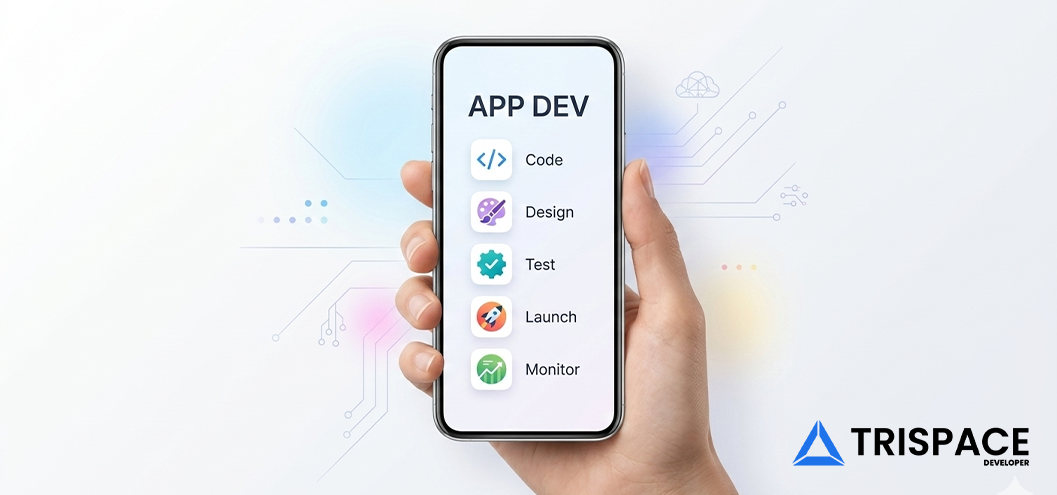
The life cycle of application development has several phases. These phases get the app ready for launch and use after it’s launched. Here are the main steps in developing a mobile app:
1. Creation of New Concepts and Ideas
This is the first stage that defines the app concept. Developers & businesses collaborate to define app goals, audience, features, etc.
2. Wireframing & Prototyping
In this stage, the designers make a rough sketch of the app layout and flow. Prototypes enable visual understandings of the app’s design and interactions (UI/UX).
3. Development & Coding
Now for the actual coding, whether it’s a native, hybrid, or cross-platform app. That’s when developers start coding functionality and make sure that the app works properly on different devices.
4. Testing & Quality Assurance
QA teams thoroughly test the app, eliminating the bugs where found. This is a step to ensure that the app is working properly and provides a seamless experience to users.
5. Deployment & Launch
Once fully tested, the app is released to the respective app stores (Google Play Store & Apple App Store). The app is then marketed to the target audience.
6. Support & Maintenance after the Launch
But the maintenance continues after the launch with regular bug fixes, deploying new features, and complying with the new devices and OS updates.
Mobile App Maintenance: Keeping Your App Fresh
Why Is App Maintenance Important?
Mobile apps require constant attention even after they’ve been launched. Regular updates and fixes are necessary to ensure the app remains compatible with new devices, operating systems, and security protocols.
Key Areas of Mobile App Maintenance:
- Bug fixes
- Performance optimization
- Regular updates to keep up with OS upgrades
- Adding new features based on user feedback
Different Types of Mobile App Maintenance
- Corrective Maintenance: Fixing bugs and issues that may arise after launch.
- Adaptive Maintenance: Ensuring the app remains compatible with new OS versions and hardware.
- Perfective Maintenance: Enhancing app features and improving overall performance based on user feedback.
- Preventive Maintenance: Monitoring the app to prevent potential issues before they arise.
Mobile App Monetization: Turning Apps into Revenue Streams
Monetization is a key consideration in the app development process. There are various strategies for making money through mobile apps:
| Monetization Strategy | Description |
| In-App Purchases | Allowing users to buy virtual goods, premium features, or subscriptions within the app. |
| Ad Revenue | Displaying ads within the app. The app developer earns revenue based on impressions or clicks. |
| Freemium Model | Offering the app for free but charging for advanced features, content, or functionality. |
| Paid Apps | Charging users a one-time download fee to access the app. |
Conclusion
The mobile app development industry is evolving at a rapid pace. With evolutionary technologies like AI, AR, and 5G, app developers have a wider range of the spectrum to create interactive and never-dying apps. Be it a native, hybrid, or cross-platform app, you will always need a common ingredient for success, which is understanding the users, updating your application regularly, and staying on top of the trends.
If businesses & developers capitalize on these stats & work around with the changed ground reality, they can surely assist their mobile apps with sure-shot success in the competitive domain.
FAQ’s:
Q1. Native vs. Cross-Platform: Which is better?
Ans. Native is best for high performance and features. Cross-platform is better for saving time and budget by using one codebase for both iOS and Android.
Q2. How long does it take to build an app?
Ans. A standard app takes 3 to 6 months. Complex apps with AI or custom backends can take 9+ months.
Q3. Why is app maintenance necessary?
Ans. To keep the app compatible with new iOS/Android updates, fix bugs, and ensure security after the initial launch.
Q4. How do free apps make money?
Ans. Mainly through subscriptions, in-app purchases, and ads. Subscriptions are currently the most successful model for long-term revenue.
Q5. How will AI and 5G change my app?
Ans. 5G allows for faster speeds and less lag, while AI creates a personalized experience by learning what your users like.